
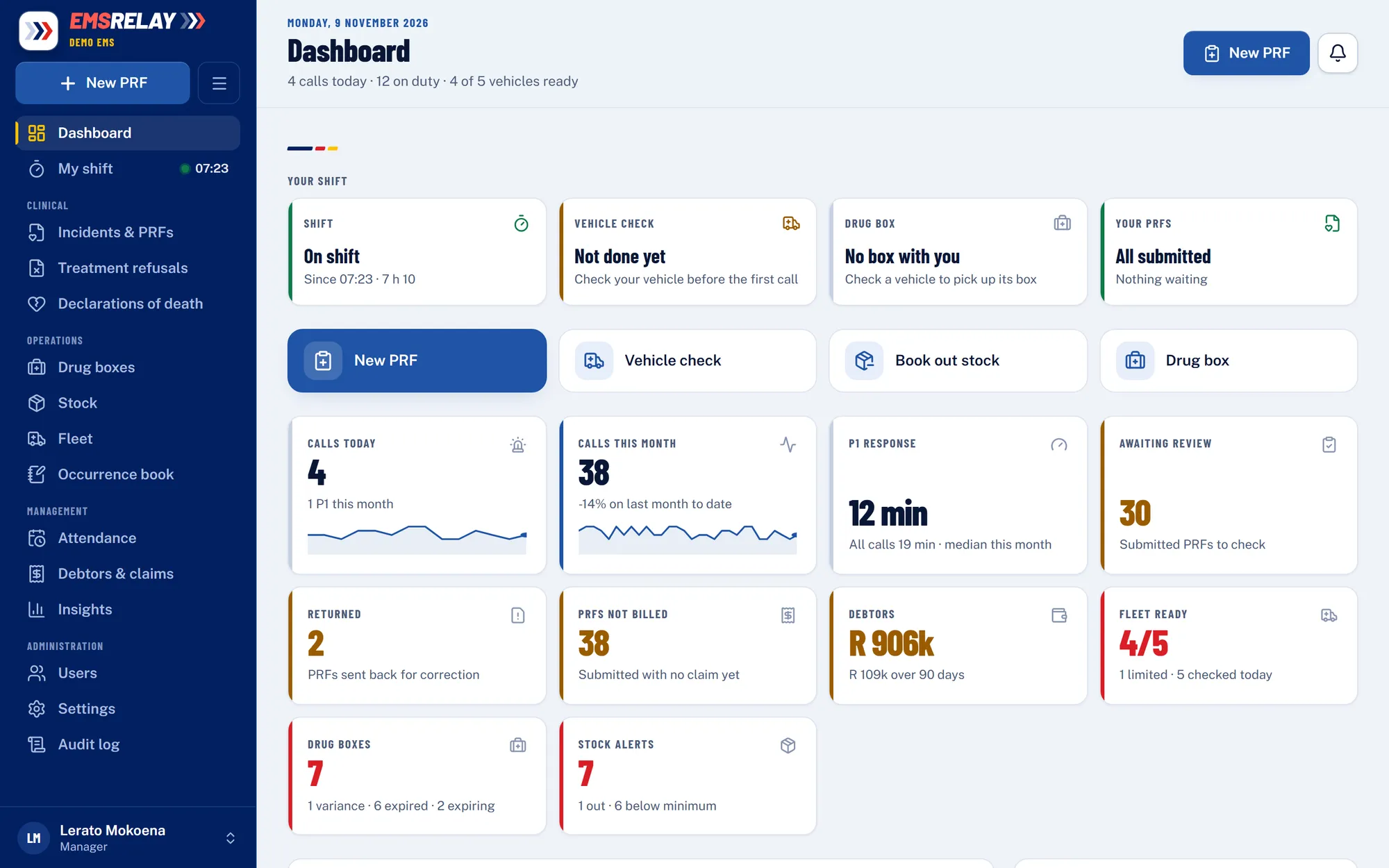
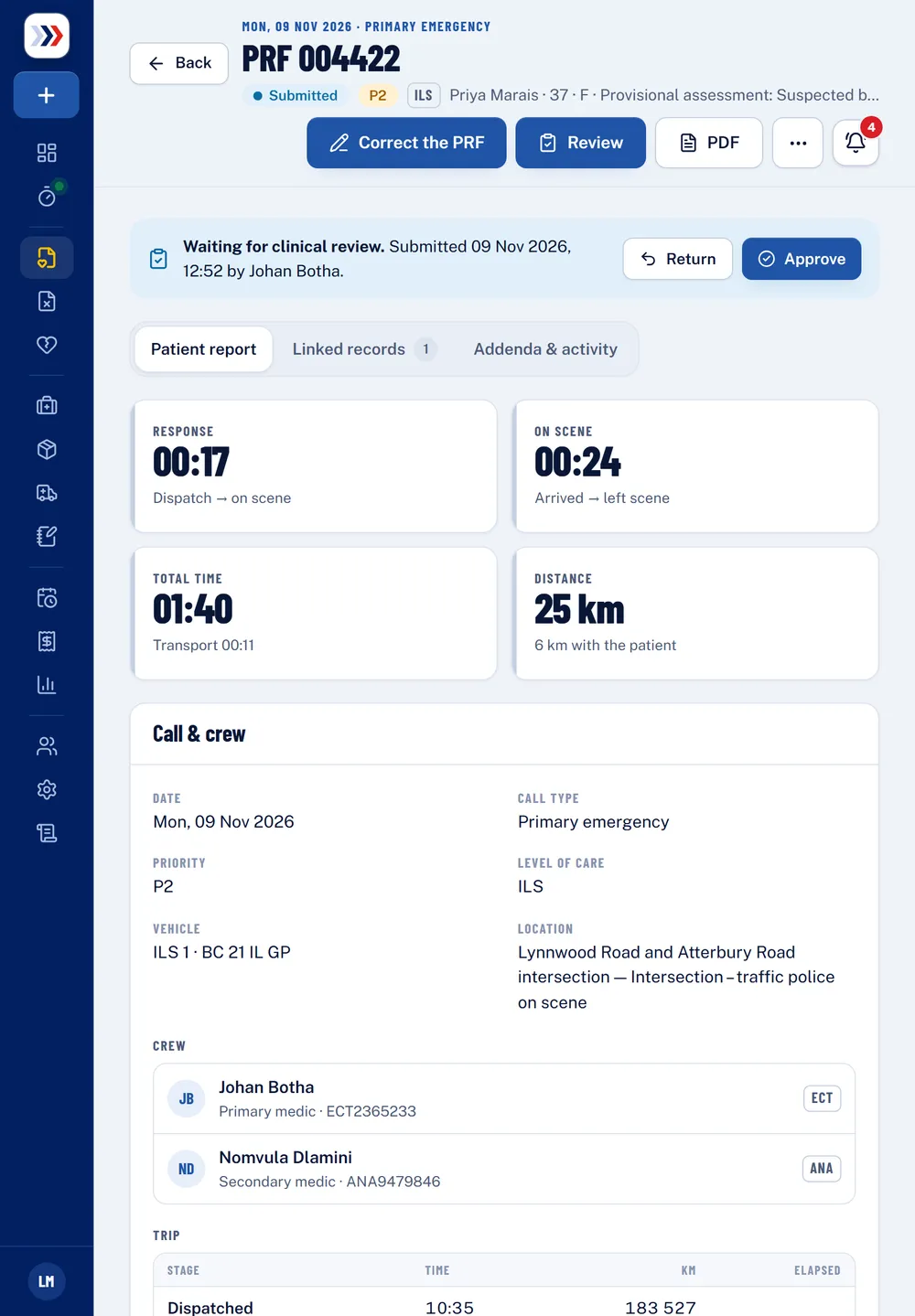
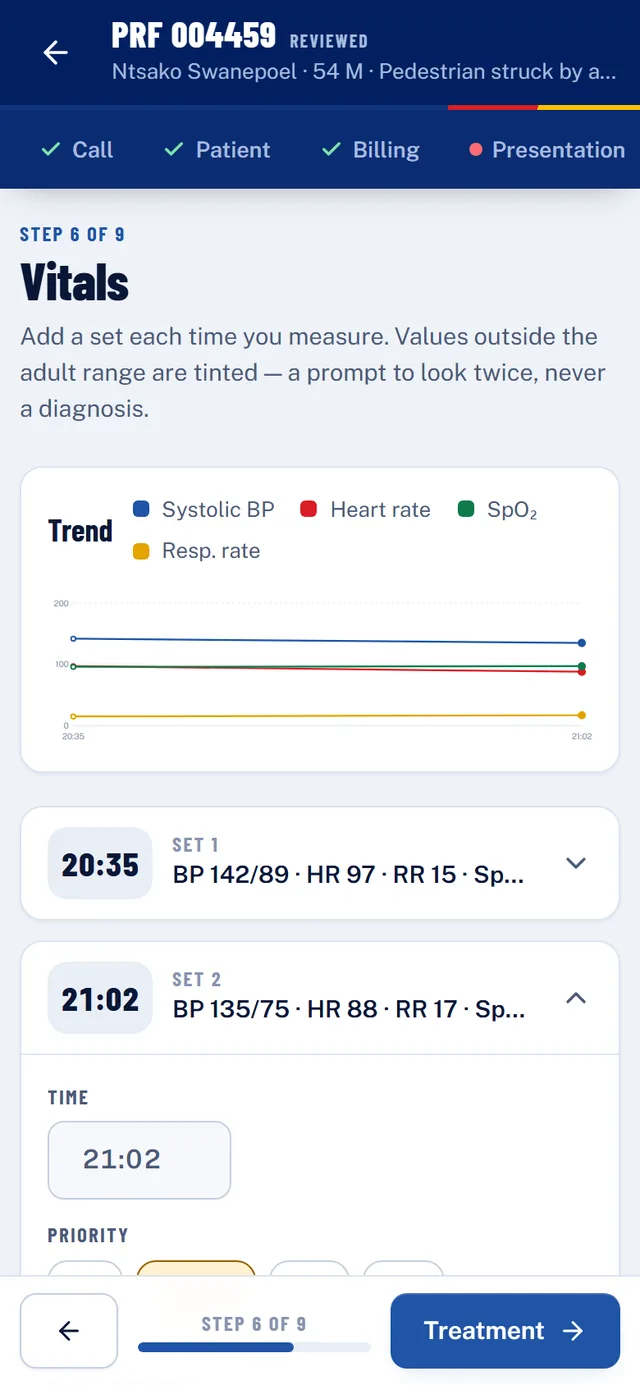
What it does
Everything between the call and the payment
One system for the crew, the clinical reviewer, the stores controller and the office — instead of paper PRFs, spreadsheets and a separate billing package.
Electronic PRF
A guided ePRF (ePCR) crews finish on scene, on any phone — even without signal.
Learn moreBilling & medical aid claims
Every PRF becomes a claim priced from your tariffs, followed until it is paid.
Learn moreControlled drug register
Every box, slot and dose signed for with a reason — Schedule 5 and 6 included.
Learn moreVehicle checks & fleet
Start-of-shift checks on a phone; critical defects take a vehicle off the road.
Learn moreDeath & refusal forms
Declarations of death and refusals of treatment, signed on screen and sealed.
Learn moreStock, shifts & occurrence book
Store rooms and book-outs, timesheets, the control-room log and insights.
Learn moreHow it works
From the call to the cash
- 1
On scene
The crew completes the electronic PRF on a phone or tablet — with or without signal.
- 2
Review
A clinical reviewer approves it, or sends it back to the crew with a note.
- 3
Claim
The claim is built from the PRF and priced from your tariffs — no retyping.
- 4
Paid
Every claim is tracked, aged and followed up until the money is in.
Scan and speak
Less typing on scene
Typing in the patient’s details and writing up the call are the slowest parts of a PRF. EMS Relay reads the first from a photo and the second from what the crew says — and the crew ticks every detail before it goes on the PRF.
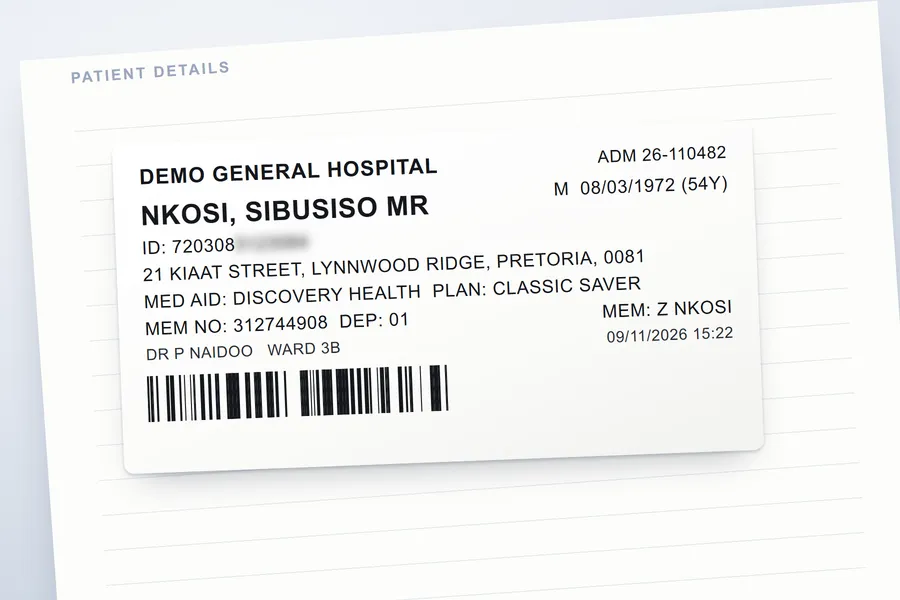
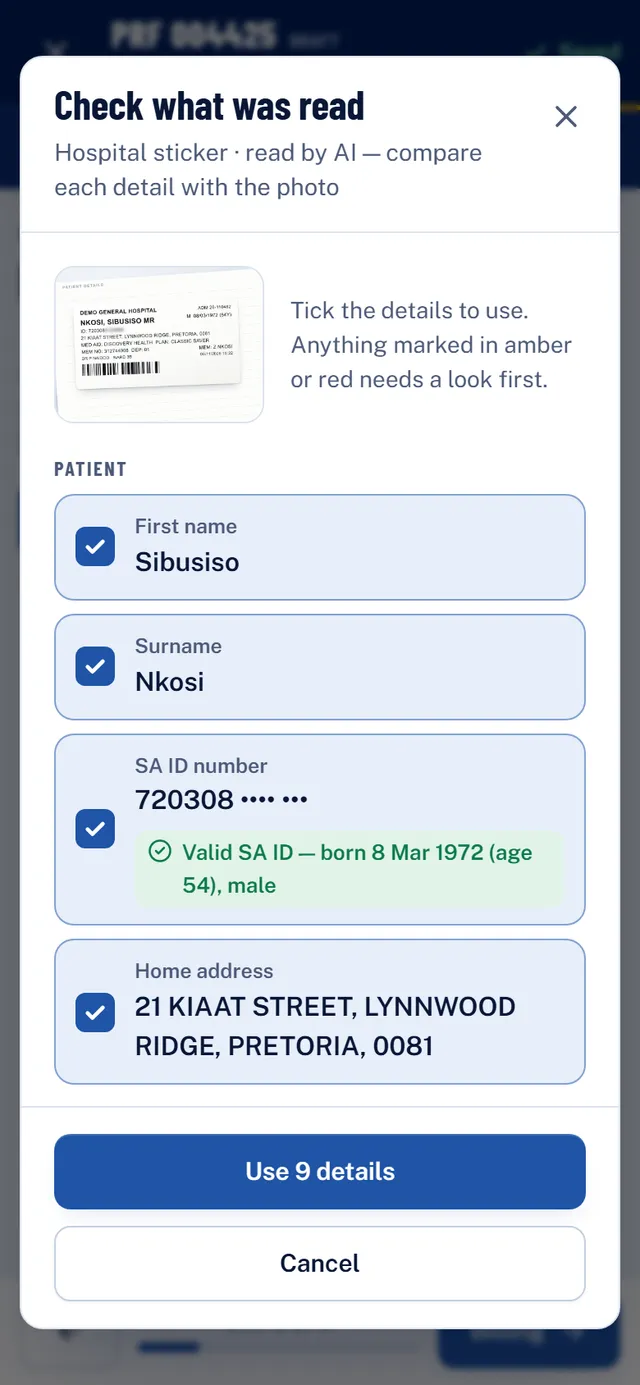
- 1Photograph the sticker or card
- 2Tick what goes on the PRF
Scan AI
Photograph the sticker — the patient’s details fill themselves
- Hospital stickers and medical aid cards are read by AI in a few seconds: name, ID number, address, medical aid, plan, membership number and dependant code.
- A smart ID card’s barcode is read on the phone itself — no signal needed, nothing sent.
- Checked before it is used: the ID number’s check digit, the medical aid against your list. Each detail sits next to the photo, only what the crew ticks goes in, and Undo takes it out again.
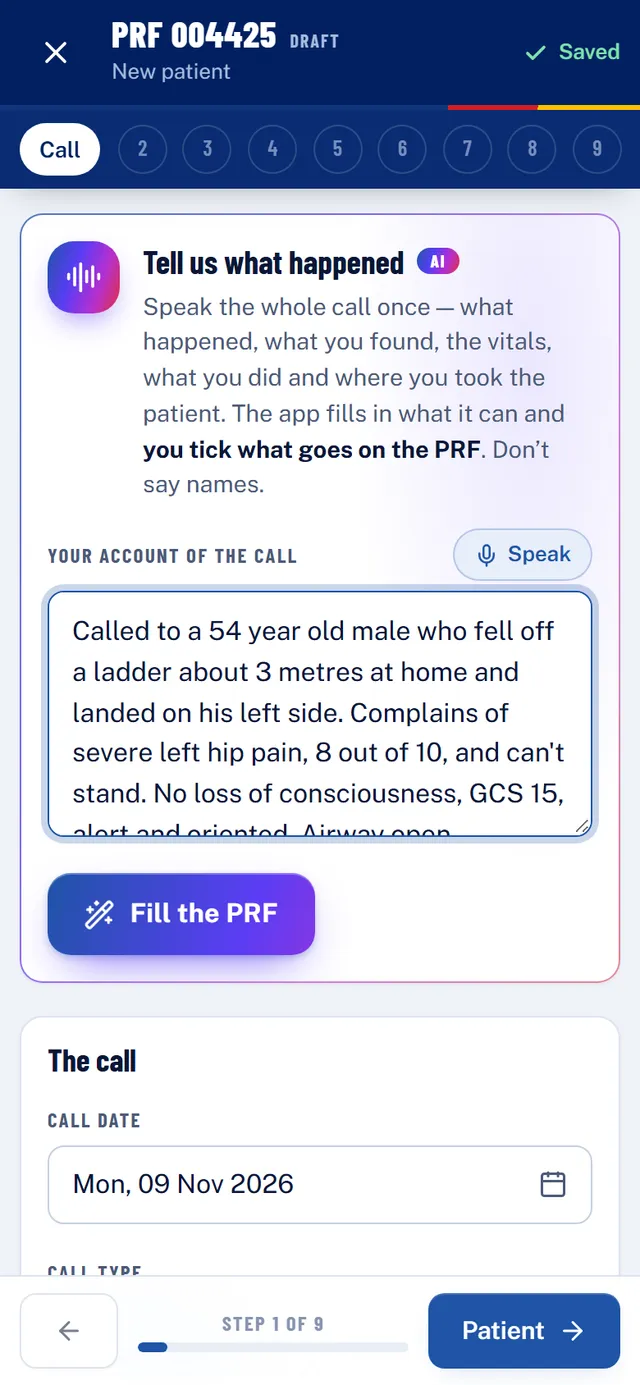
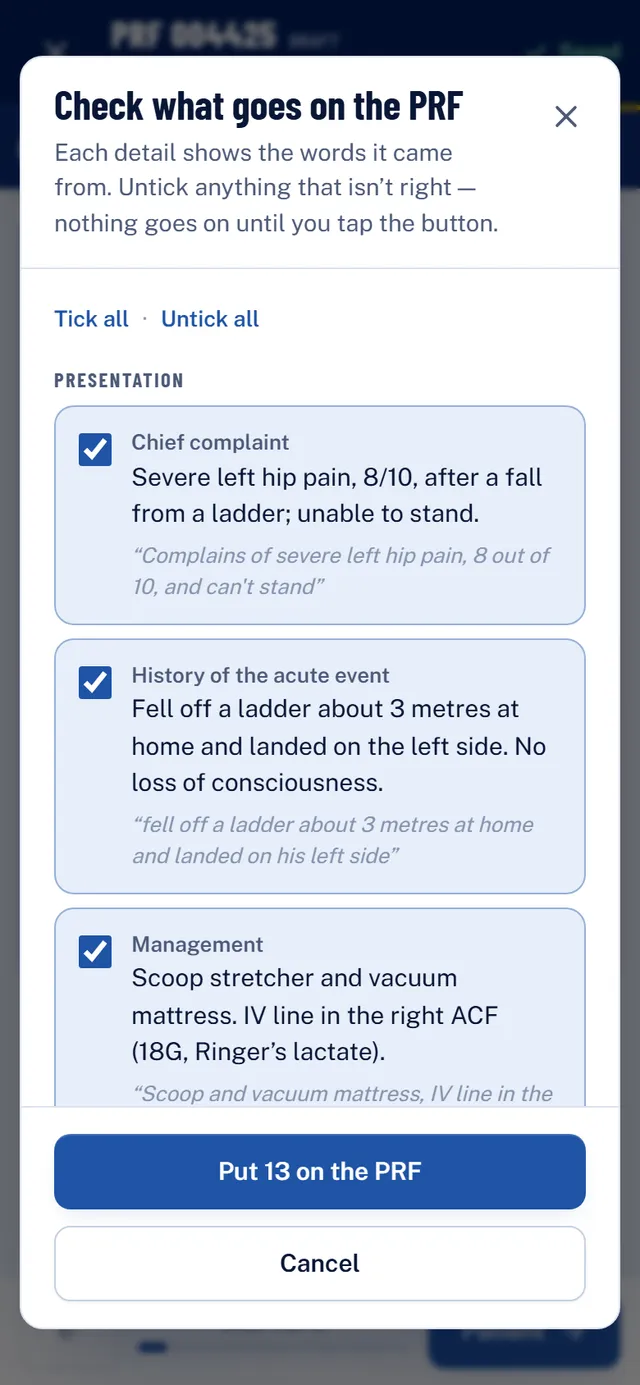
- 1Speak the whole call
- 2Tick what goes on the PRF
Speak AI
Tell us what happened — and the PRF fills itself
- Tap Speak and tell the whole call once: what happened, what you found, the vitals, what you did and where you took the patient.
- The PRF’s steps fill in — presentation, surveys, vital signs, IV lines, equipment and handover — each detail showing the words it came from.
- Checked in the app, not trusted: a number nobody said is left out, and medication is never filled in — drug-box doses go through the register.
Write the notes for me AI
Drafts the chief complaint, history and management from what the crew recorded — checked against it before the crew sees it.
Or start from a template
Ready-written clinical notes for 80+ presentations at BLS, ILS and ALS level. Every word stays editable.
Your call
The AI that writes stays off until a manager switches it on, names are taken out before a spoken account is sent, and nothing is logged.
For the office
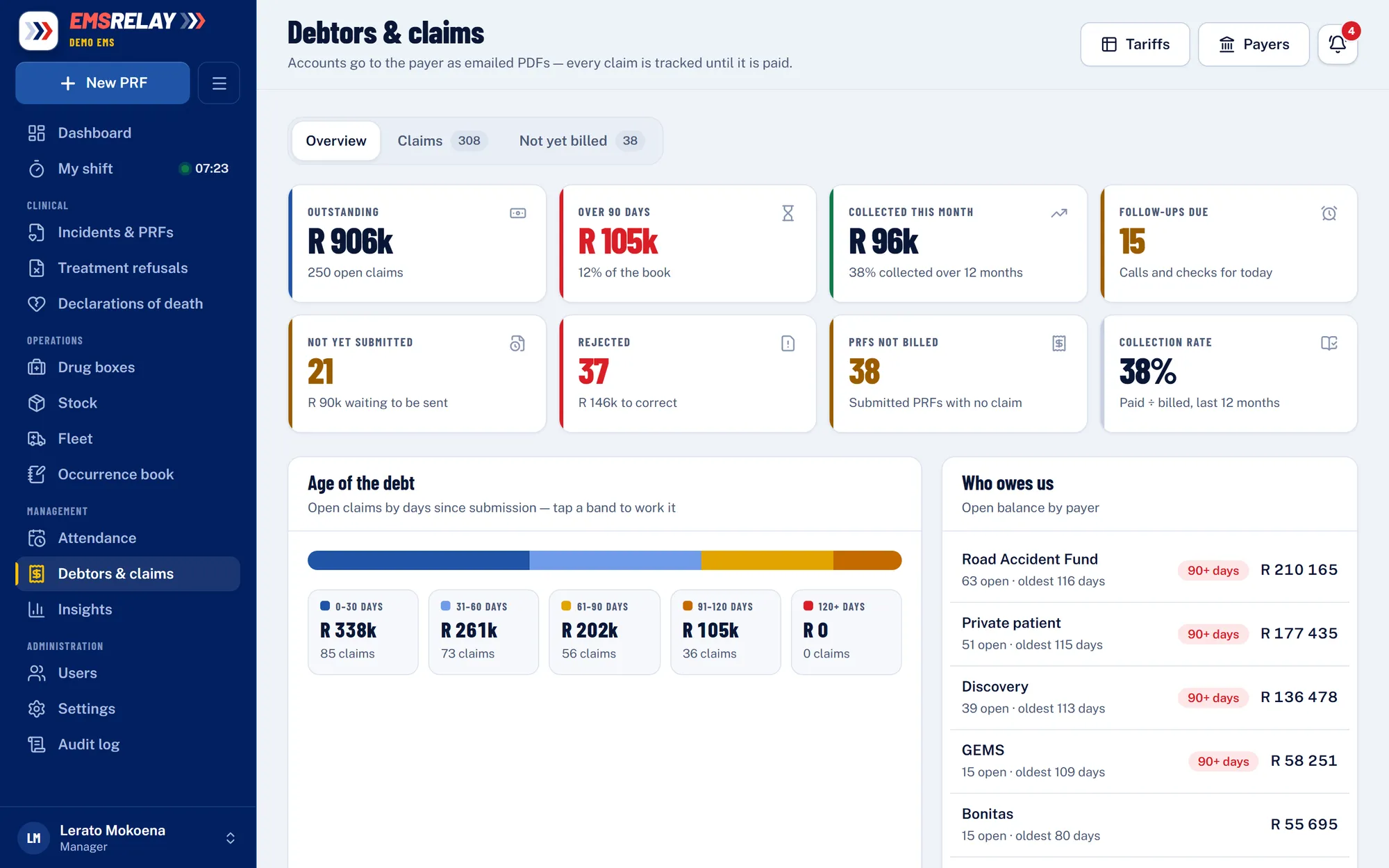
Know where every rand is
- Outstanding, overdue and rejected claims at a glance.
- The age of the debt and who owes you, per medical aid, RAF, COIDA or private patient.
- A daily list of claims to follow up, so nothing slips through.
Made for South Africa
Built around how EMS works here
SA ID numbers checked
The check digit and date are verified and fill in the date of birth, age and gender.
Medical aids, RAF and COIDA
Every payer type a South African ambulance service bills — plus private, contract and indigent cases.
HPCSA numbers on every PRF
Each crew member’s qualification and HPCSA number, with registration expiry tracked.
ICD-10 and cause codes
Your own lists, suggested by the clinical template the crew picks.
Schedule 5 and 6 drugs
A witness for every disposal, and a register an inspector can follow.
Rand tariffs per medical aid
Claims priced from each rate card, billing time and kilometres from the PRF.
Security · POPIA
Built for patient information
Two-step sign-in
Every user is invited and signs in with a password and a code from an authenticator app.
South Africa only
Your system can only be reached from inside South Africa.
Tamper-evident records
Each submitted PRF is sealed with a digital fingerprint, and every action is in the audit log.
Your own private system
Each service runs separately, on its own address, with its own database.
Built with a working ambulance service
EMS Relay was designed together with a private ambulance service in Pretoria — around their real patient report forms, medical codes, drug boxes and billing rules. Not around a slide deck.
Questions
Good to know
What is EMS Relay?
EMS Relay is ambulance and EMS software for South African private ambulance services. It puts the electronic PRF (ePRF, also called an ePCR), billing and medical aid claims, the controlled drug register, vehicle checks, declarations of death and refusals, stock, shifts and the occurrence book in one system.
Who is it for?
Private ambulance services, event medical services and inter-facility transfer operators — the crews on the road, the clinical reviewers, the stores controller and the office that bills and gets paid.
Does it work without signal?
Yes. The PRF saves on the phone as the crew works and sends itself when the signal is back.
Do we need to install anything?
No. EMS Relay runs in the web browser on any phone, tablet or PC, and crews can add it to their home screen like an app. There are no servers for you to run.
Can it use our own PRF numbers, codes, drugs and tariffs?
Yes. Your PRF, refusal and declaration numbers carry on from your current system, and your service is set up with its own ICD-10 and cause codes, drug lists and drug boxes, vehicle check lists, medical aids and tariffs.
How is patient information protected?
Every user is invited and signs in with a password and an authenticator code, your system can only be reached from South Africa, every submitted report is sealed with a digital fingerprint, every action is in an audit log, and each service runs on its own separate system. More on security and POPIA.
Does it use AI?
Where it saves the crew time, and the crew checks every detail. AI reads a photographed hospital sticker or medical aid card (a smart ID card’s barcode is read on the phone itself). A manager can also switch on AI that drafts the clinical notes or fills the PRF from the crew’s spoken account — names are taken out before anything is sent, and it stays off until it is switched on. Nothing AI reads or writes goes on the PRF until the crew ticks it.
How do we get started?
Book a demo at [email protected]. We walk you through EMS Relay with your own call types, medical aids and tariffs, then set up your service's system with your lists and invite your team.
See it with your own calls
A 30-minute walkthrough using your call types, medical aids and tariffs. No obligation.