
What it does
From PRF to payment, without retyping
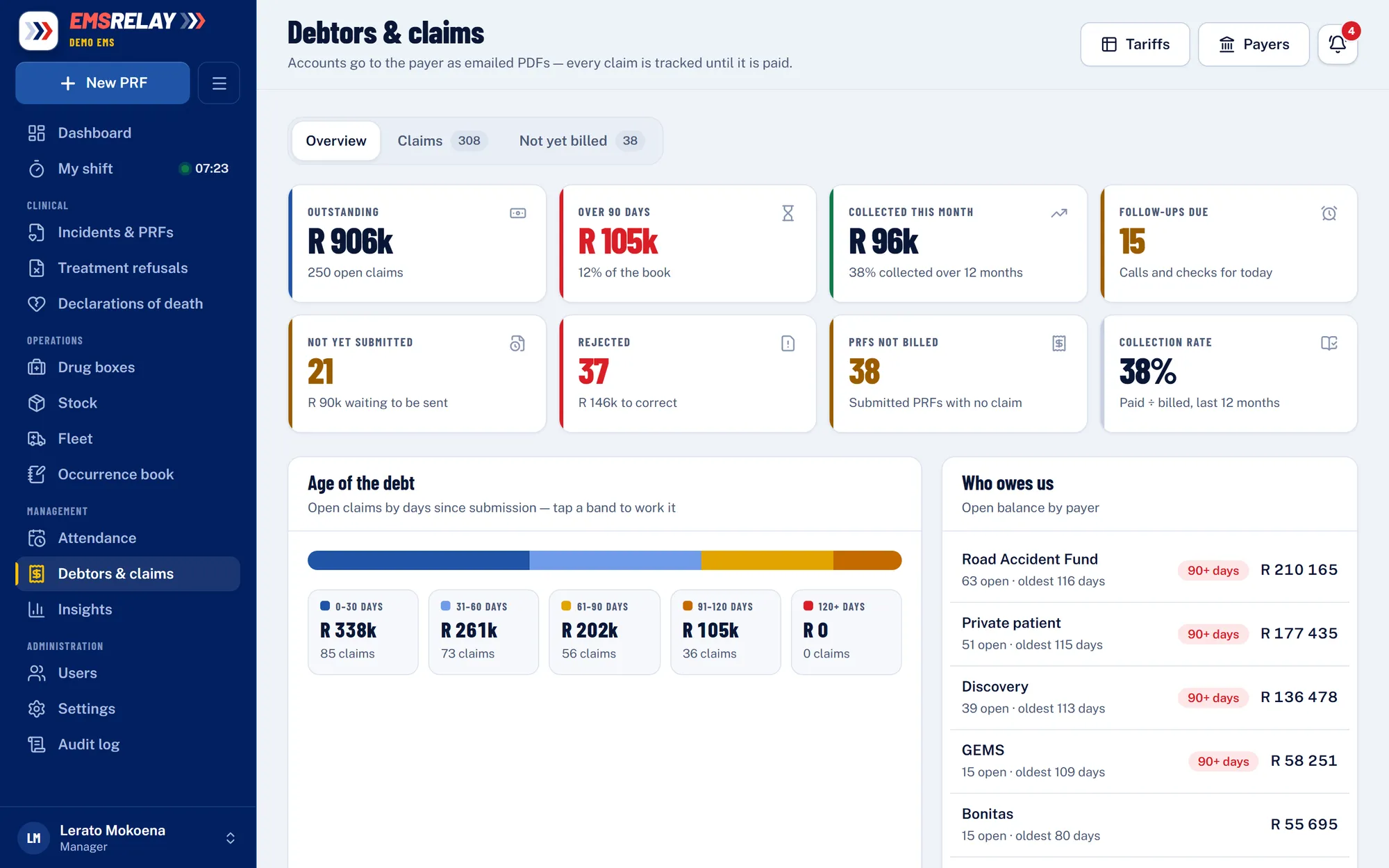
Billing is where an ambulance service gets paid — or doesn’t. EMS Relay builds the claim from the record the crew already completed, so the office spends its time following up, not capturing.
Claims built from the PRF
Patient, medical aid, member number, dependant code and authorisation come straight from the PRF the crew completed.
Priced from your tariffs
Each medical aid’s rate card, with billing time and kilometres worked out from the PRF’s trip times and odometer.
Every payer type
Medical aids, private patients, the Road Accident Fund (RAF), injury on duty (COIDA), contracts and indigent cases.
Sent as a PDF to the scheme
Each claim is a clear PDF emailed to the medical aid’s claims address, line by line.
Payments and short payments
Record payments, short payments, rejections and write-offs against each claim.
Debtors ageing
Outstanding money by 0–30, 31–60, 61–90, 91–120 and 120+ days, who owes you, and billed against collected.
Follow-ups that happen
Each claim has a follow-up date and an owner, and the office gets a daily list of claims to chase.
Nothing left unbilled
A list of submitted PRFs not yet billed, so no call is forgotten.
The right people only
Accounts staff see billing; crews don’t. Roles and permissions are yours to set.
Scan the medical aid card AI
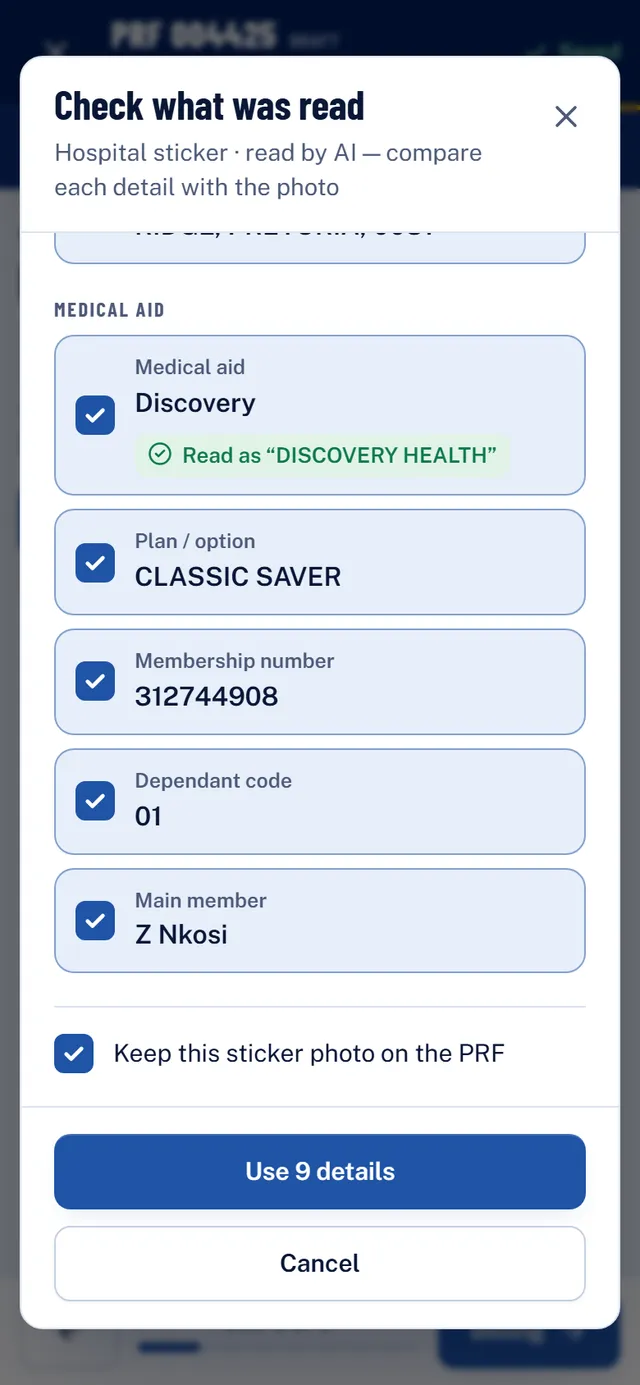
Member details from the card, not from memory
- The crew photographs the medical aid card or the hospital sticker: scheme, plan, membership number, dependant code and main member are read from it.
- The scheme is matched to your list of medical aids — a new one is flagged for the office to check.
- Ticked by the crew on scene, then straight onto the claim. No retyping, no guessing at a member number.
How a claim moves
From the PRF to the bank
- 1
PRF submitted
The crew’s PRF carries the payer, member details, times and kilometres.
- 2
Claim built
Priced from the payer’s rate card; the office checks it line by line.
- 3
Sent
Emailed to the medical aid as a PDF, with a follow-up date set.
- 4
Paid
Payments, short payments and rejections recorded until the claim is closed.
Questions
Good to know
Can we use our own tariffs?
Yes. Each medical aid or payer has its own rate card in EMS Relay, and claims are priced from it using the billing time and kilometres on the PRF.
Does EMS Relay submit claims electronically?
Claims are emailed to each medical aid’s claims address as a PDF, and every payment, short payment and rejection is recorded against the claim.
What about RAF and COIDA claims?
The crew picks the payment type on the PRF — medical aid, private, RAF, injury on duty (COIDA), contract or indigent — and the claim follows from it.
Can the office correct a claim before it goes out?
Yes. A claim can be edited line by line before it is sent, and every change is recorded.
See your own claims in EMS Relay
A 30-minute walkthrough with your medical aids, tariffs and call types.